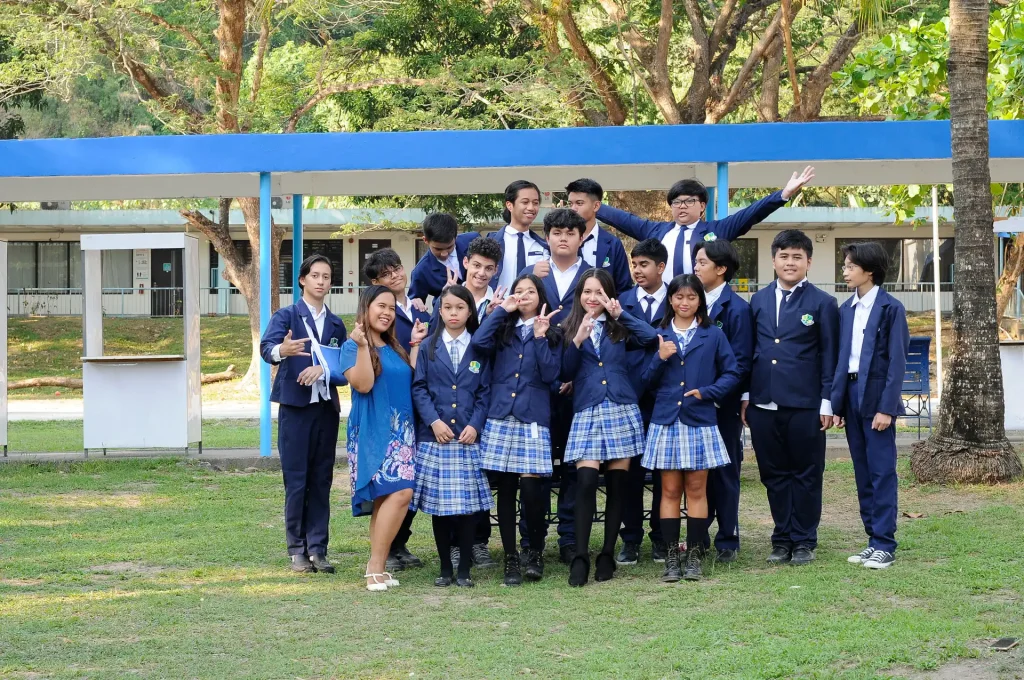
Junior High School
Overview
The Junior High School program at The Manila Times College of Subic covers Grades 7 to 10 and serves as a critical stage in the K to 12 continuum. During these years, students transition from foundational learning to more advanced academic engagement. The program is designed to deepen subject knowledge, strengthen analytical thinking, and cultivate independence in learning.
Aligned with the Department of Education curriculum and strengthened by the school’s ongoing development as an International Baccalaureate candidate school, Junior High instruction emphasizes inquiry, structured research, collaboration, and reflective learning. Students are guided to move beyond memorization toward understanding concepts, making connections across disciplines, and applying knowledge in meaningful ways.
Curriculum Framework
The Junior High School curriculum follows the DepEd K to 12 framework and is structured to ensure both breadth and depth of learning across subject areas. Instruction is competency-based and uses a spiral progression approach, where key concepts are revisited with increasing complexity as students advance through each grade level.
Core learning areas include:
- English and Filipino, focusing on advanced reading comprehension, academic writing, oral communication, and literature analysis
- Mathematics, developing logical reasoning, algebraic thinking, problem solving, and application of mathematical concepts
- Science, covering life sciences, physical sciences, earth science, and introductory research skills through observation and experimentation
- Araling Panlipunan (Social Studies), strengthening historical understanding, civic awareness, cultural literacy, and global perspectives
- Edukasyon sa Pagpapakatao, reinforcing ethical decision-making, personal responsibility, and social values
- MAPEH (Music, Arts, Physical Education, and Health), promoting creativity, wellness, physical development, and appreciation of the arts
- Technology and Livelihood Education (TLE) and Information and Communication Technology (ICT), building practical skills, digital literacy, and technical competence
Instruction integrates research tasks, collaborative projects, and performance-based assessments that encourage students to demonstrate understanding rather than recall information alone.
Instructional Approach
Junior High classrooms at TMTCS promote active participation and guided inquiry. Teachers facilitate discussions, group activities, and research-based projects that allow students to explore ideas and articulate their understanding. Students are encouraged to ask questions, evaluate information, and present their findings clearly and confidently.
As part of the school’s IB candidacy journey, learning strategies increasingly emphasize critical thinking, intercultural awareness, communication skills, and responsible use of information. Reflection and self-assessment are gradually introduced to help students become more aware of their strengths and areas for growth.
Student Development and Leadership
Beyond academics, the Junior High program supports character formation and leadership development. Students are encouraged to participate in school organizations, academic competitions, outreach initiatives, and co-curricular activities that strengthen teamwork and responsibility.
Guidance programs and structured mentoring help learners navigate academic challenges and personal growth. Discipline, respect, accountability, and collaboration are consistently reinforced as part of the school culture.
Preparation for Senior High School
By the end of Grade 10, students are expected to demonstrate academic readiness and personal maturity necessary for Senior High School. The program intentionally develops research competence, organizational skills, and independent study habits that prepare learners for specialized strands such as STEM, ABM, and HUMSS.
Through sustained academic rigor and character development, Junior High School ensures that students are prepared to make informed decisions about their future pathways and to succeed in higher levels of education.